


Comprehensive guide to the badminton rules: From the basics to professional play
Introduction to the rules of badminton
Badminton is much more than just a simple racket sport. Originally derived from the Indian game of Poona and introduced to England in the 19th century, this racket sport has earned its place on the international stage, particularly at the Olympic Games. It has become a global sport prized for its dynamism and competitiveness. Whether in professional competition or a casual game among friends, badminton captivates with its combination of agility, speed, and precision. The main objective is simple: to score points by hitting the shuttlecock into the opponent's court while preventing them from returning it. In this article, we'll explore the basic rules of this exciting sport, its specific dimensions, and the fundamentals to help you get started or perfect your game. Ready to learn more and hit the court?
Dimensions of the field and height of the net
The badminton court is carefully dimensioned to ensure a fluid and strategic game. In doubles, the court measures 13.4 meters in length and 6.1 meters in width, providing more space for teamwork. In singles, the width is reduced to 5.18 meters, forcing players to adjust their strategy and positioning. The net, the central element of the court, is attached to the posts at a height of 1.55 meters and slopes slightly downwards to 1.524 meters in the center, creating a gentle curve and offering players an additional challenge. This unique configuration of the court and net promotes precise shots and quick movements, essential elements for mastering this sport.

Basic rules of the game (use keywords)
To properly begin a badminton match, some basic rules must be known. The game starts with a coin toss to determine the first server and which side of the court they will serve on. The serve must be executed in a specific way: the shuttlecock must be struck below the waist and fly over the net without touching it. Each rally ends when a player fails to return the shuttlecock within the opponent's court, resulting in a point for the other player. Points are accumulated to 21, but to win the set, a player must have a lead of at least two points. If the score reaches 20-20, play continues until one player achieves a two-point lead or until a maximum of 30 points is reached, which immediately determines the winner. This dynamic scoring system makes every rally crucial and increases the intensity of each match.

Badminton serving rules
The serve is a fundamental move in badminton, and mastering it can make all the difference during a match. There are several types of serves, each suited to specific situations. The underhand serve is often used to force the opponent to hit the shuttlecock close to the net, limiting their offensive options. The overhand serve, on the other hand, sends the shuttlecock deep into the back of the court, ideal for keeping the opponent at a distance and setting up an attack. Finally, the drive serve is fast and at chest height, designed to surprise the opponent and give them little time to react. To execute these serves correctly, it is crucial to hit the shuttlecock below waist level and keep the racket tilted downwards. Common errors include hitting the shuttlecock too high, an uneven toss, or a foot crossing the service line. By following and practicing these badminton rules, players can avoid service errors and gain an advantage right from the start of the rally.
Singles and doubles matches
Badminton is played in two distinct formats: singles and doubles, each with its own specific rules and positioning requirements. In singles, each player covers the entire court, requiring good stamina and the ability to move quickly to reach shuttlecocks diagonally and into the corners. The serve in singles is determined by the score: on an even score, the server serves from the right side, and on an odd score, from the left. In doubles, the court is enlarged, giving both players more space to cover. The serve in doubles is also affected by the score, but each player must switch roles between serving and receiving after each point won. Furthermore, players switch sides with their partners after each point as server. This rotation and spacing require effective coordination to cover the court well and optimize movement, making doubles rallies particularly dynamic and strategic.
Badminton courts and important lines
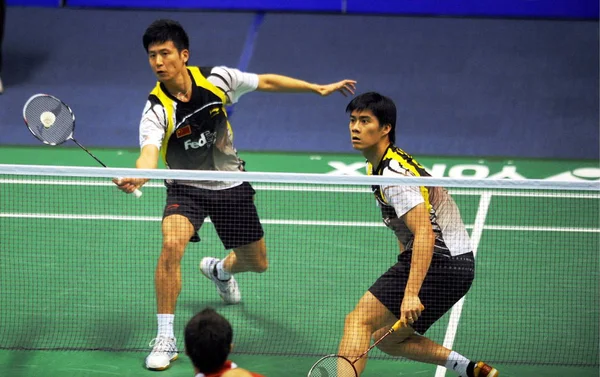
The badminton court is divided into essential lines that define the playing zones and influence the strategy of each rally. Measuring 13.4 meters long and 6.1 meters wide for doubles (reduced to 5.18 meters in singles), the court is marked with several lines that play a crucial role. The center line separates the two service zones, while the baseline defines the back boundary of the court. The sidelines vary depending on the format: in singles, the playing zone is narrower, and the inner lines are used as boundaries; in doubles, the playing zone extends to the outer lines. The service line and long service line determine the area where the serve must land to be valid in doubles. These markings force players to adapt their positioning and strategy according to the format, adding an important tactical dimension to the game and the movements on the court.
Points awarded and end of game
The scoring system in badminton is designed to add excitement and intensity to every match. Games are played to 21 points, and it is crucial to reach this score with a lead of at least two points. If the score reaches 20-20, play continues until one player or team achieves this two-point lead, which can extend the tension to 29-29. In this case, the game ends immediately at 30 points, with the score at 30-29, determining the winner. This dynamic structure means that every point counts, and players must remain focused, as a single rally can change the course of the game. Furthermore, the determination of the winner can vary in competitions depending on the format of the match, particularly in multi-set matches, where the first player to win two sets is declared the overall winner. This structure makes badminton especially captivating, with every point being an opportunity to turn the tide.
Here you will find our selection of equipment to help you win your games:
Errors and violations
In badminton, several common errors can significantly impact the course of a match. A frequent error is stepping over the service line, which occurs when a player crosses it during a serve, resulting in a loss of serve. Another common error is serving incorrectly, such as serving with the shuttlecock too high or not thrown properly. Such errors often lead to an immediate point conceded to the opponent. Net touching is also prohibited: if a player touches the net during play, whether intentionally or accidentally, the other player loses the point. These violations highlight the importance of understanding the badminton rules and paying attention during the game to avoid conceding points and maximizing one's advantage.
Conclusion and outlook for the game
Badminton isn't just a sport; it's also a fantastic way to stay fit, develop strategies, and socialize. Whether you're new to the game or looking to improve your skills, understanding and mastering the rules is the first step to progress. The game not only enhances fitness and coordination but is also an excellent way to spend time with friends and enjoy healthy competition. Remember, badminton has a dynamic that allows both beginners and professionals to showcase their abilities in tournaments. So grab your racket, find a partner, and discover the joy and fun that badminton has to offer!
Everything about rugby rules: The complete guide from beginner to professional
Which sport suits me?
Related Posts

How to improve your shooting in basketball

Volleyball Rules

The history of basketball

How to install a basketball net in 5 steps

How high is a volleyball net?

15 game ideas for the gym: From warm-up games to team games for elementary school

Which badminton racket is right for you? – The ultimate guide to choosing a racket


