


Handball Rules: A brief overview of the most important rules of the game
Handball is one of the most popular team sports in Germany and enjoys great popularity internationally. Particularly in Europe, with countries like France, Spain, and Denmark leading the way, handball has firmly established itself as a mainstream sport. In Germany, the Handball Bundesliga (HBL) is one of the strongest and most competitive leagues in the world, underscoring the popularity of this dynamic and fast-paced sport. Handball not only offers excitement for fans but also demands a high level of fitness, technique, and teamwork from its players.
To fully understand and enjoy the game, it is essential to know the basic rules. Whether as an active player, referee, or spectator – understanding the rules helps to better comprehend the game, make the right decisions, and fully exploit the game's dynamics.
Team composition and player roles
A handball match is played by two teams, each with seven players on the court. These are six field players and one goalkeeper. The field players can occupy different positions, each with specific responsibilities within the game. The most common positions are:
- Backcourt players (left, center, right): They are often the main players in attack, setting up the game and trying to score goals by shooting from a distance.
- Wingers (left and right): These players operate on the wings of the field and are responsible for quick attacks and precise shots on goal from the side.
- Pivot player: This player moves in a circle around the goal area and tries to break through the defense through body contact and quick movements.
- Goalkeeper: The most important defensive role, responsible for protecting the goal from the opposing team's shots.
Besides the fixed starting lineup, handball offers flexible options for player substitutions. Each team has unlimited substitutions during the game, which can be made "on the fly" without interrupting play. This allows teams to constantly bring in fresh players, make tactical adjustments, and react flexibly to game situations.
A special rule concerns the use of an extra field player: In certain situations, teams can replace the goalkeeper with another field player to gain a numerical advantage in attack. This leaves the goal unprotected, which is a risky but often effective tactical option.
A proper understanding of the team setup and the distribution of roles on the playing field enables players to act more efficiently and to make optimal use of each player's individual strengths.
Playing field and equipment
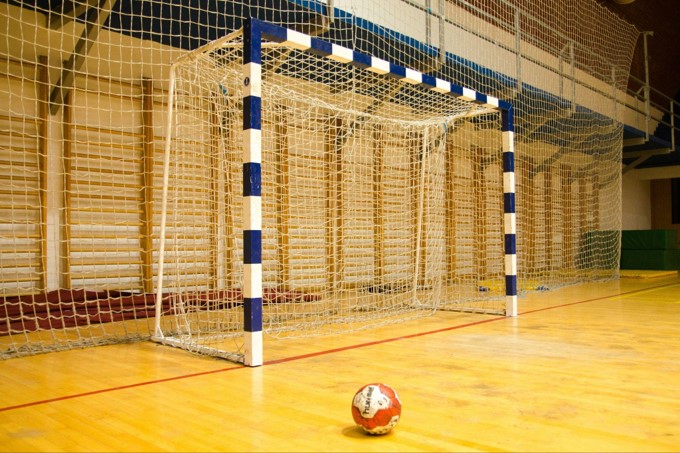
The handball court has fixed dimensions and is clearly divided into different zones. It measures 40 meters in length and 20 meters in width and is structured by several lines. The most important line is the goal area line, located 6 meters in front of the goal and marking the area that only the goalkeeper is allowed to enter. In front of the goal area line (9 meters away) is the free-throw line, which is essential for taking free throws. Another prominent line is the center line, which divides the court into two halves.
The goals are located at both ends of the playing field and have a standardized size of 3 meters wide and 2 meters high. The nets behind the goals catch the ball after a successful shot.
The ball used in handball differs depending on gender and age group. A handball is made of leather or synthetic material and is specially designed to provide good grip, which is crucial for quick passes and precise throws. Men play with a ball that has a circumference of 58 to 60 cm, while the ball for women and youth is slightly smaller (circumference of 54 to 56 cm). Compared to other ball sports like football or basketball, handball is smaller and easy to grip with one hand.
Basic rules of the game
A handball match consists of two30-minute halves. There is a short 10-minute break between halves. If the game ends in a draw and a winner is required (e.g., in tournament matches), the game continues with two 5-minute overtime periods. If the score is still tied after overtime, a penalty shootout decides the winner.
Steps and dribbling are central elements of handball. A player may hold the ball and take up to three steps before passing, bouncing, or attempting a shot on goal. During dribbling, a player is allowed to take any number of steps. A violation of this rule results in a turnover, and the opposing team is awarded a free throw.
Fouls occur when a player obstructs or attacks an opponent through illegal conduct. Depending on the severity of the offense, there are various penalties:
- Yellow card: This warning signals to the player that he is bordering on illegal behavior. A yellow card has no immediate consequence, but can lead to harsher penalties if the behavior continues.
- Two-minute penalty: For more serious rule violations or repeated offenses, the player is sent off the field for two minutes, and his team must continue playing with fewer players.
- Red card: In handball, a red card is issued for serious fouls or a third two-minute suspension. The player is excluded from the game, but after two minutes the team can continue playing at full strength.
- Blue card: In addition to the red card, the blue card signals a serious rule violation and the incident may be reviewed afterward. This can result in further disciplinary action after the match.
Knowledge and understanding of these basic rules are crucial for playing or following handball correctly and with tactical skill. They ensure fairness and structure and enable a dynamic game that relies on speed and teamwork.

Throws: Types and rules of execution
In handball, there are various types of throws, each used depending on the game situation. The most important are the penalty throw, the free throw, the throw-in, the goal throw, and the throw-in. Each of these throws has specific rules and conditions that govern the game and ensure fairness.
Seven-meter throw
The seven-meter throw is similar to a penalty kick in football and is used when a serious foul is committed against a player during a clear goal-scoring opportunity, or when an illegal action prevents the opponent from scoring a certain goal. The throw is taken from the seven-meter line, and only the thrower and the goalkeeper are allowed in the playing area at that moment. All other players must remain behind the free-throw line (nine meters) until the throw is taken. The thrower has a maximum of three seconds to throw the ball at the goal once the referee gives the signal.
Free throw
A free throw is usually awarded for minor rule violations or when play is interrupted, for example, due to a technical foul or a rule violation by the opposing team. The free throw is taken from the spot where the foul occurred, but not inside the six-meter goal area line. Opposing players must maintain a distance of at least three meters from the thrower. A direct shot on goal from the free throw is permitted if the ball has not been touched before the throw.
Throw-in, throw-off and throw-in
- The throw-in restarts play at the beginning of each half or after every goal. It is taken from the center line, and the ball must complete at least one full rotation before being touched by another player. The throw-in allows the attacking team to restart play from a central position.
- A goal throw is a special throw made by the goalkeeper after the ball has crossed the goal line without a goal being scored and was last touched by the attacking team. The goalkeeper may make the throw from within their goal area to restart play.
- A throw-in is taken when the ball has left the field of play over the touchline. The throw-in is taken from the point where the ball crossed the line. The player taking the throw-in must have one foot on or just behind the line and bring the ball back into play from there.

Extra time in handball and timeouts
How long does overtime last in handball? Handball is known for its exciting and often close games, which is why there are clear rules for overtime and timeouts to determine a winner or to adjust tactics.
Rules for overtime: how long is overtime in handball?
If a match ends in a draw after the regular playing time of 60 minutes (two 30-minute halves) and a winner is required (e.g., in tournament matches), the game is decided by overtime. This consists of two 5-minute halves. If there is still no winner after these two additional halves, either another overtime period or a penalty shootout follows. In the penalty shootout, five players from each team take turns shooting at seven-meter throws. If there is still no winner after this, the penalty shootout continues into a knockout phase until one team wins.
Time out
How many timeouts are allowed in handball? Each team is entitled to three 60-second team timeouts during regulation time. However, only one timeout can be used per half, and it is only permitted when the team is in possession of the ball. These timeouts are typically used to discuss tactics, give players a short break, or prepare specific plays for crucial moments.
In overtime, each team receives one additional timeout. Timeouts are a crucial tactical tool, especially in the final minutes of close games, to deliberately influence the outcome.
With these clearly defined throwing techniques, overtime rules and time-out options, handball offers a well-thought-out set of rules that promotes both the dynamics of the game and ensures fairness.
Tactics and referee rules
In handball, the rules have a significant influence on team tactics. For example, the rule that a player may only take three steps with the ball forces teams to use quick passing and dynamic off-the-ball movement. This requires precise communication and clear spatial awareness to find gaps in the opposing defense.
Replacing the goalkeeper with an extra outfield player also opens up interesting tactical variations. In situations where a team is trailing or wants to exploit a numerical advantage, the additional outfield player can help put more pressure on the opposing defense. However, this strategy carries risks, as the goal remains unprotected if possession is lost.
Another important tactical aspect is the exploitation of time penalties. If an opponent has one less player on the field, the opposing team will try to keep possession of the ball longer and deliberately create numerical advantages in order to score more easily.
The role and responsibilities of referees
Referees play a crucial role in handball, ensuring the game remains fair and governed by the rules. Typically, there are two referees per match, both of whom oversee the court. They are responsible for enforcing the handball rules, evaluating fouls, and issuing penalties such as yellowcards, suspensions, or red cards. Their decisions significantly impact the game and demand a high level of attention and sensitivity.
In modern handball tournaments and leagues, video technology is increasingly used to review controversial incidents, especially penalty shot decisions or serious fouls. These video replays help to make correct decisions and ensure fair play, particularly in crucial and close situations.

Development of the handball rules
Handball has evolved steadily since its beginnings at the start of the 20th century. Originally , the game was played with eleven players per team on a football field. The rules we know today – with seven players per team on an indoor court – only became established over the course of decades.
In recent years, numerous rule changes have made the game even more dynamic and faster. One of the most important innovations was the introduction of the quick restart after a goal. This allows teams to take the restart immediately after conceding a goal, resulting in a significantly faster game rhythm and fewer interruptions.
The rule allowing the goalkeeper to be replaced by an additional field player has also recently been officially enshrined, leading to new tactical possibilities. Modern handball is designed to make the game more attractive, faster, and more action-packed through these rule changes.
Discover our handball products at the following links:
Conclusion
Handball is a fascinating and fast-paced sport characterized by clear rules and dynamic tactics. From the basic rules and team composition to the various types of throws, tactical nuances, and the role of the referees – all these elements contribute to the excitement and intensity of the game.
For players, it is crucial to know the rules precisely in order to act tactically and make the best use of their own abilities. Spectators also benefit from a good understanding of the rules of the game in order to better follow the action on the field.
Anyone who studies the handball rules in depth will be able to experience the game in all its depth and sophistication – whether as an active player or as an enthusiastic fan.
Related Posts

Handball throwing power training: The complete guide for more power, technique & throwing speed

Handball training for children


